

Key Takeaways
- Students quit in month two, not month five — the intro offer ends, novelty fades, and habit has not yet formed.
- The 60-day intervention — anchoring practice, building a recurring slot, and personal outreach — prevents the month-two cliff.
- Community retention is not about events — it is about named introductions, the post-class door moment, and creating conditions where students feel recognized.
- Visit frequency predicts retention more than any other metric — twice-weekly attenders are half as likely to cancel as once-weekly.
- A 5% improvement in retention can increase profitability by 25-95% — retained students require no acquisition cost and often increase spending over time.
The month-two cliff
Most yoga studios offer a $30-50 intro month or 30-day unlimited pass. During that window, students come frequently — often 3-4 times per week — because the sunk cost motivates them. When the offer ends and regular pricing kicks in, attendance normalizes. Students who have not built a genuine practice habit in weeks one to four find reasons not to come in weeks five to eight.
This pattern is predictable enough that you can identify at-risk students before they quit. A student who attended 8-10 times in month one and drops to 2-3 visits in month two is displaying the exact pattern. Flag them at day 35 and intervene personally.
The studios with 65%+ 12-month retention run a specific 60-day intervention that prevents this pattern. The transition from intro offer to regular pricing is the single most consequential moment in a yoga student's journey.

The 60-day retention sequence
Days 1-14: Anchor the practice
- End of first class: confirm next booking in person, or make it trivially easy to self-book the same time next week.
- Day 3: welcome message with a specific class recommendation based on their stated goals.
- Day 10: a check-in message — not a sales pitch, just: how is the practice going? Do you have questions about what class to try next?
Days 15-35: Build the recurring slot
- Move the student from ad hoc booking to a specific recurring class they claim as their own.
- At session five: introduce them by name to another regular student in their class.
- End of month one: a personal conversation about membership — tied to their attendance pattern, not a promotional email.
The conversation should be simple: you have been coming three times a week — that is a drop-in each time. The monthly membership covers unlimited classes and holds your spot in the Tuesday 6pm. Want to set that up? Short. Specific. No pressure.
Days 36-60: Catch the drift
- A student who misses two consecutive classes in months one to three needs a personal message within 48 hours.
- Not an automated we-miss-you email. A message from their instructor: hey, did not see you in Tuesday's class — hope everything is good. Are you still planning to come this week? The 7pm Thursday slot has space if Tuesday does not work.
This approach works because it is specific — it names their class, their instructor, their usual time — and low-pressure. Studios that run instructor-triggered personal messages for missed classes in months one to three recover 30-40% of those at-risk students.
Community is recognition, not events
The biggest misconception about retention is that you need to host events to build community. The studios above 70% retention know that community retention is not about events — it is about creating conditions where students feel recognized as individuals.
Three things that move retention metrics:
Named introductions
When a regular student is waiting before class, take 30 seconds to introduce them to a new student. This is Maria — she has been coming to this class for two years. You will be in good hands. New students who know someone's name by week three retain at meaningfully higher rates than those who do not.
The post-class door moment
Instead of closing the studio the instant class ends, build five minutes of intentional social time. Teachers standing at the door, greeting departing students by name, creates the moment of belonging that anonymous fitness classes do not have. It costs nothing.
Twice-annual non-fitness event
One workshop focused on practice — pranayama, philosophy, anatomy — and one purely social gathering per year. The workshop reinforces the value of the studio beyond fitness. The social event creates friendships. Students with friends at the studio are dramatically less likely to cancel a membership when life gets busy.

Schedule consistency beats variety
Students who find a class time and teacher they trust and attend it consistently are the students you keep. A rotating schedule that moves popular classes around, introduces new formats monthly, and does not anchor specific teachers to specific slots creates churn because it never allows that anchor to form.
Protect your most popular time slots. The Tuesday 7pm Vinyasa with a specific teacher should be the same teacher, same room, same slot for 12+ months. Build variety in lower-demand slots. Keep your core schedule stable.
Consistency of schedule is more important than variety of formats.
The metrics that matter
Most studios track cancellations — a lagging indicator that tells you what already happened. The leading indicators tell you what is about to happen, and the difference is 30-60 days of intervention time.
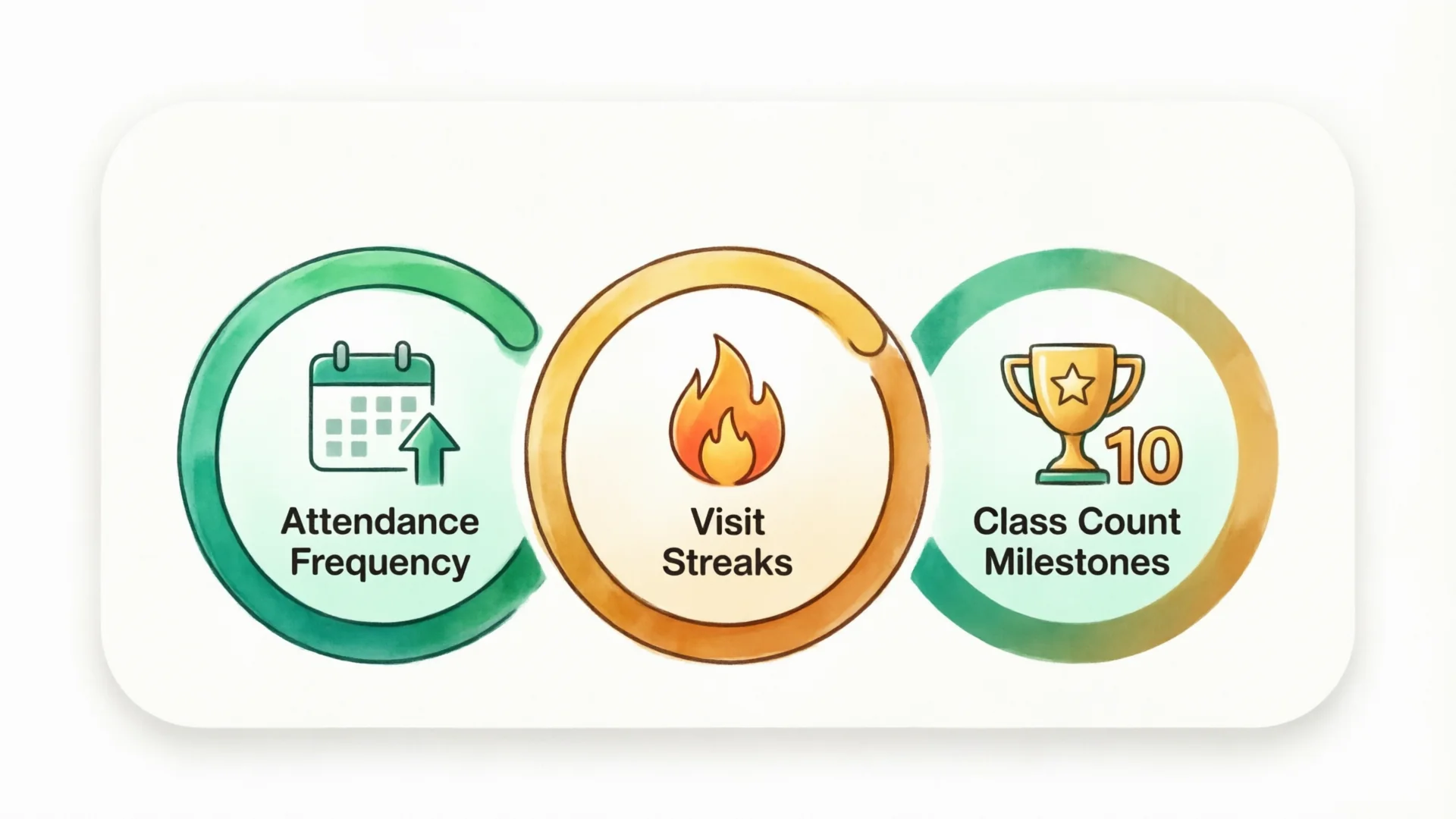
Attendance frequency decline
A member who typically attends three times per week and drops to once per week for three consecutive weeks has a 68% probability of churning within 60 days. This is the single most powerful signal.
Days since last visit
For members with a history of regular attendance, 14 days without a visit is a meaningful gap. For sporadic attenders, the threshold shifts to 21-28 days.
The 8-class threshold
Members who attend 8+ classes in their first month have a 90%+ chance of staying past six months. Those who attend fewer than 4 classes in month one have a 60% chance of canceling before month three. This is the strongest predictor of long-term retention.
Visit frequency
Members who attend at least twice weekly are roughly half as likely to cancel as those visiting once weekly or less. Group class participants are 56% more likely to retain than those exercising alone.
Why price is almost never the real reason
The most commonly cited cancellation reason is price, with roughly 41% of members claiming a membership is too expensive. But price is almost always a proxy for lack of engagement.
Students attending three times per week at $150 per month perceive a cost of $12.50 per class. Students attending once per week perceive $37.50 per class for identical access. The membership did not become more expensive — the value collapsed because the student stopped showing up.
This is why retention is fundamentally a teaching problem, not a pricing problem. When students feel connected to a teacher, connected to other students, and connected to a practice that is progressing, price becomes secondary. When those connections do not form, no discount is enough.
Start small, stay consistent
You do not need to overhaul your entire teaching practice. Start with three things:
- Learn one new name per class and use it during instruction.
- Stand at the door for five minutes after class and greet students by name.
- Send a personal message to any student who misses two consecutive classes in their first three months.
These three habits — recognition, presence, and personal outreach — cost nothing and create the conditions where students feel seen. When students feel seen, they keep coming back. Their practice deepens, and your teaching becomes more fulfilling.
The math is stark: a studio with 200 active members at 75% annual retention loses 50 members per year, requiring $90,000 in replacement revenue just to stay flat. Improving that retention by 5% — just 10 more students staying — can increase profitability by 25-95%. That is the compounding power of retention: every student you keep is a student you do not need to acquire, and they bring referrals, workshop bookings, and community energy that no marketing campaign can buy.