Your mat has a whole ecosystem living on it
Your yoga mat touches bare skin, absorbs sweat, and sits on the floor for an hour at a time. It's the most intimate piece of gear you own — and it's also the one most people never wash.
Here's the uncomfortable part. Studies of fitness-center equipment have measured bacterial loads on mats and machines that are orders of magnitude higher than what's typically found on surfaces you'd actually worry about. One widely cited environmental-health review found shared gym mats can harbor up to 25 times more bacteria than a toilet seat. High-friction zones — knees, palms, toes — collect the most.
That's not meant to scare you. Regular, correct cleaning removes the vast majority of that buildup. What we want is a simple routine you'll actually stick to.
Before we start, one distinction matters. Cleaning and disinfecting are not the same thing. As the Cleveland Clinic puts it, cleaning uses soap or detergent to remove dirt and germs, while disinfecting uses chemicals to kill them. For your own personal mat at home, soap and water is enough. Disinfecting becomes important for shared mats at studios and gyms — where you don't know whose skin, sweat or shoe soles touched it last.
How often should you clean your yoga mat?
The honest answer: more often than you think, less often than a full wash.
| Routine | How often | What to do |
|---|---|---|
| Quick wipe-down | After every session | Spray with a mat-safe solution, wipe with a soft cloth |
| Spot clean | Weekly | Scrub sticky spots (sweat lines, dust) with a damp cloth |
| Deep clean | Every 2–4 weeks | Full wash, rinse and flat dry (below) |
| Disinfect | After hot yoga, shared use or illness | Use a mat-safe disinfectant and respect contact time |
If you practice hot yoga or sweat heavily, shift everything up a notch — wipe every session and deep clean every couple of weeks. Sweat pooled on a warm mat is exactly the damp, humid environment where bacteria and odor thrive.
What you actually need
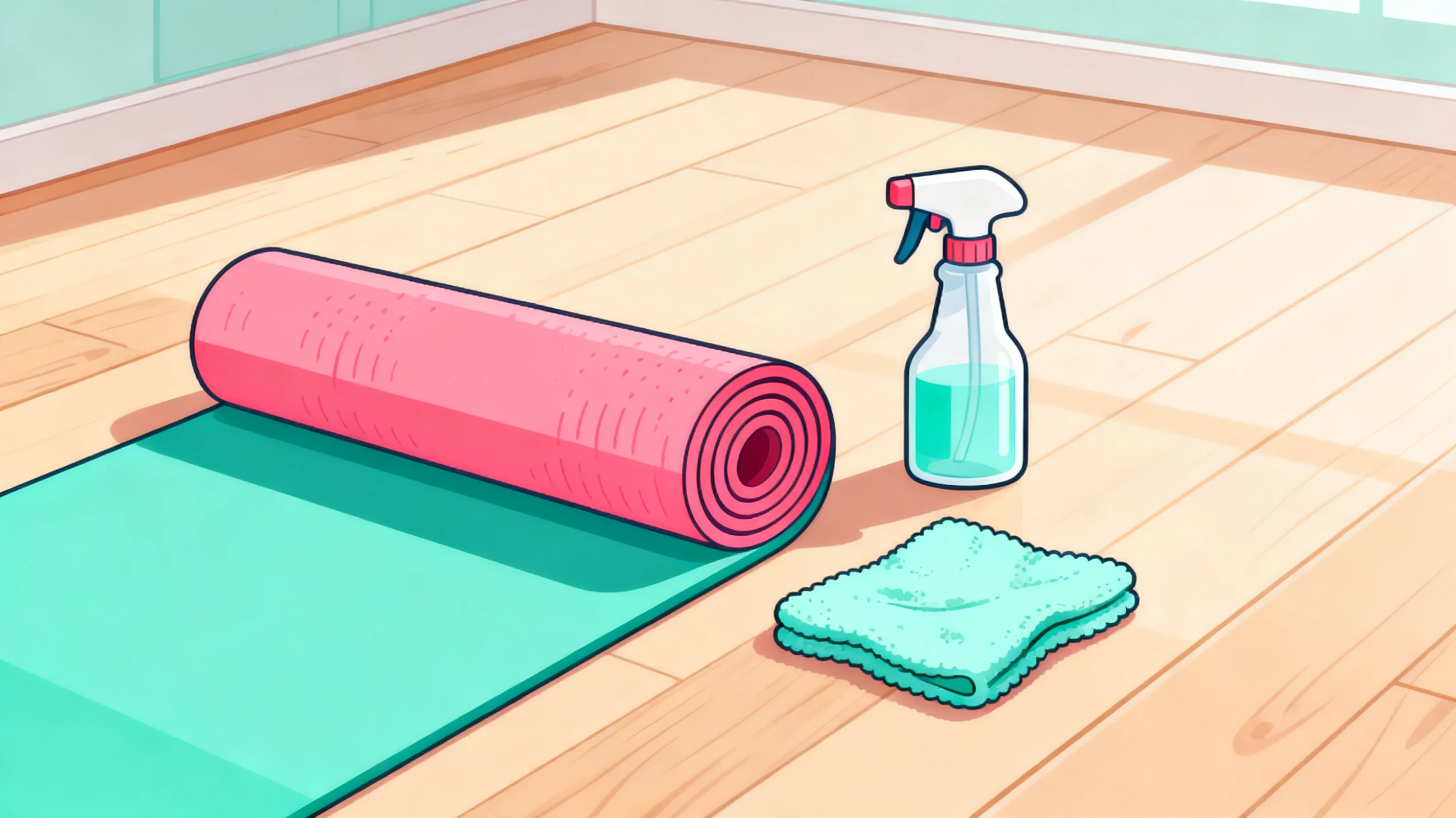
Keep it simple. Most mats clean perfectly with:
- A soft microfiber cloth (two if you have them)
- A spray bottle
- Mild liquid soap (a couple of drops) or a dedicated yoga mat cleaner
- Cool or lukewarm water
- A flat spot to dry
That's it. You do not need bleach, alcohol sprays, or the washing machine.
What NOT to use — seriously
- Bleach — strips the surface and can make foam brittle
- Alcohol sprays — they dry out and crack foam and natural rubber
- The washing machine — unless the brand explicitly says machine-washable, the agitation and spin will damage the mat and cause rapid aging
- A garden hose or bathtub soak — most mats shouldn't be soaked; water gets into the foam core and never fully comes out
- Essential-oil-only sprays — research on disinfecting PVC mats found 'natural' cleaners performed about the same as plain water against bacteria. Nice smell, limited disinfection. Fine for a refresh, not for sanitizing a shared mat.
The step-by-step deep clean (the only method you need)
Do this in your kitchen sink, bathtub, or outside on a clean surface — anywhere the mat can lie flat.
Step 1 — Make the solution. Fill your spray bottle with cool water and add a few drops of mild soap. Shake gently. (Want to disinfect? Skip the essential oils and use an EPA-registered disinfectant that's safe for your mat material — see below.)
Step 2 — Spray the whole surface. Both sides, if you can reach them. Don't drown it — a light mist is plenty.
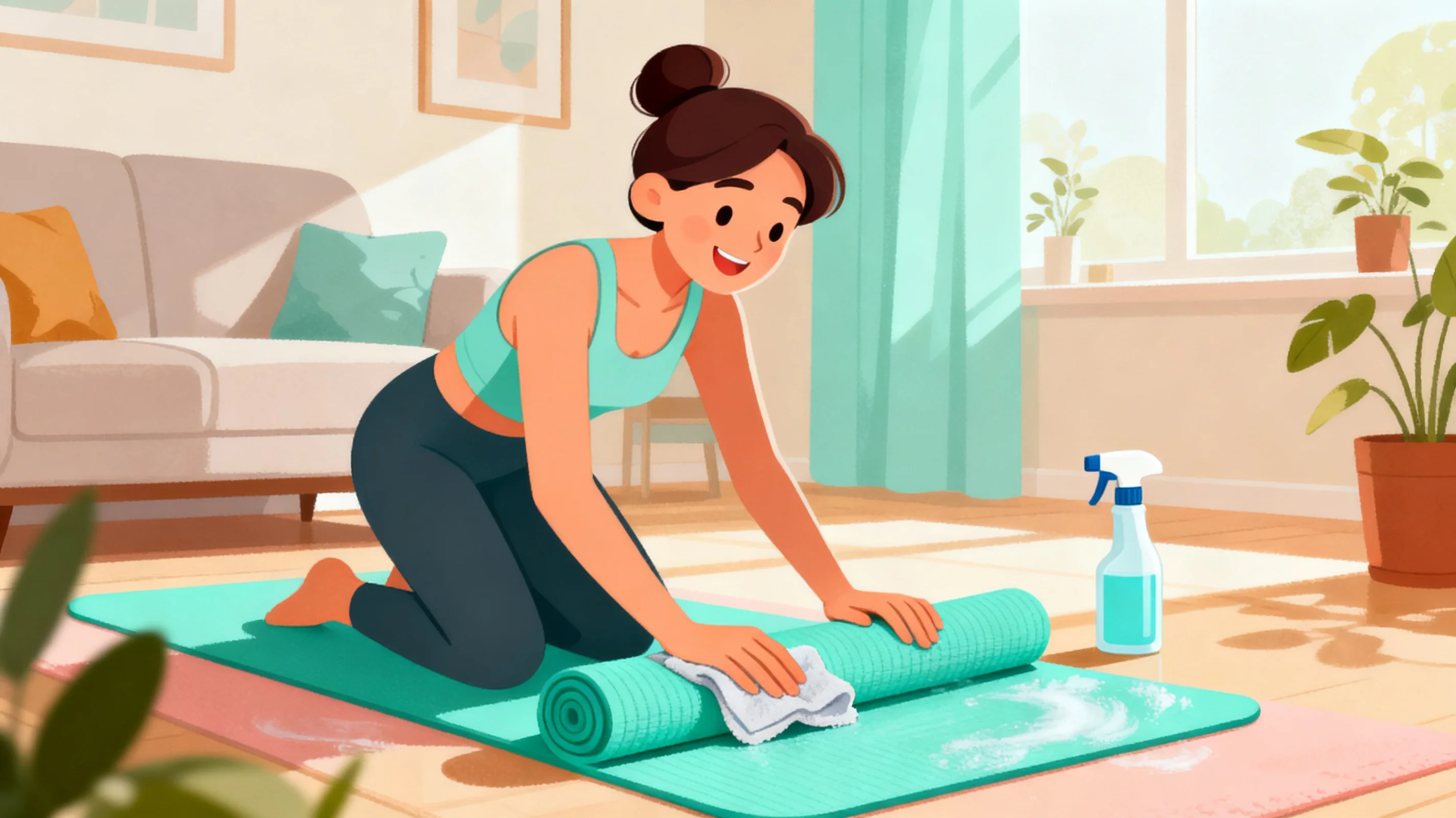
Step 3 — Wipe top to bottom. Work in long strokes with your cloth. Pay extra attention to the zones that get the most sweat: where your head rests, your hands in down-dog, and your feet.
Step 4 — Rinse the cloth and do a clean-water pass. This step is the one most people skip, and it's important. Soap residue left on the surface attracts more dirt and can make the mat slippery. A second pass with a clean, damp cloth fixes both.
Step 5 — Dry it flat. Lay the mat out flat, away from direct sunlight and heat. Give it a full hour — or two if you practiced hot yoga. Never roll it up wet. A rolled, damp mat is how mildew and odor get started.
Cleaning by mat material
Different mats, different rules. Know what yours is made of before you pick a cleaner.
High-density TPE / PVC-free foam
This is what AuraYogaMat mats are made of — TPE (thermoplastic elastomer), a non-toxic, PVC-free, odor-free closed-cell foam. Good news: it's the easiest material to care for. The closed-cell structure means nothing soaks in, so a surface wipe genuinely cleans it.
- Safe: mild soap and water, or a commercial mat cleaner
- Wipe after every session, deep clean monthly
- Roll and store dry, out of direct sunlight
PVC mats behave similarly — closed-cell, easy to clean, but heavier and less eco-friendly than TPE. Same cleaning routine applies.
Natural rubber
Rubber has incredible grip but it's sensitive. Skip the vinegar, oils, and strong or scented soaps — they break down the material, fade color and weaken the texture. Clean with a barely-damp cloth and a tiny amount of very mild soap. Dry flat indoors, away from sunlight.
Cork
Cork is naturally antimicrobial, which means bacteria don't thrive on it the way they do on foam or rubber. That's a real advantage. Still give it a gentle wipe-down with mild soap and water, and dry it away from heat — cork can warp when overheated.
What about disinfecting?
For a personal home mat, you're fine with soap and water. But after hot yoga, after a shared class, or if you've been sick, disinfecting is the move.
Two rules to keep it safe:
- Use a mat-safe disinfectant. EPA-registered disinfecting sprays are fine on non-porous mats (TPE, PVC). Never use them on moisture-absorbing mats like natural rubber or hot-yoga towels — the liquid soaks in and can't be rinsed out.
- Respect the contact time. A university study of disinfectants on PVC yoga mats found effectiveness dropped dramatically when people sprayed and immediately wiped. Read the label — most disinfectants need several minutes of wet contact to work. Then rinse thoroughly with a clean damp cloth so residue doesn't sit on your skin.
How to dry and store so it lasts
- Dry flat, out of the sun. Heat and UV degrade foam over time — cracks, discoloration, lost grip.
- Roll it loose, not tight. Store it away from radiators and garage heat.
- If it smells after a deep clean and full dry, you likely had buildup for a while. Do a second deep clean with slightly warmer (not hot) water, then dry completely before rolling.
- Wipe your mat BEFORE you roll it after sweaty sessions — trapped sweat is the #1 cause of odor and skin irritation.