

Key Takeaways
- Ten minutes beats zero — a short daily routine outperforms long occasional sessions.
- Move before you demand: gentle first, deeper as the body warms.
- Breathe out into every stretch — exhaling is what tells muscles to release.
- A mat makes it happen: cushioned knees, a defined spot, and a visible cue that the routine exists.
- Skip the classic mistakes: bouncing, holding your breath, and chasing pain.
Why mornings work
Overnight, joints stiffen and fluid settles; the first movements of the day feel creaky because tissues genuinely are cold. A brief morning stretch reverses that — Harvard Health notes even a simple 15-minute routine measurably improves how the body moves through the rest of the day.
You don't need ambition for this. You need a spot, ten minutes, and a surface kind to kneeling joints — which is exactly what an always-ready mat provides.

The setup
The trick is removing decisions: lay the mat out the night before, keep water nearby, and give yourself permission to stop at ten minutes. Put your phone across the room if you scroll in bed — the routine should replace the scroll, not follow it.
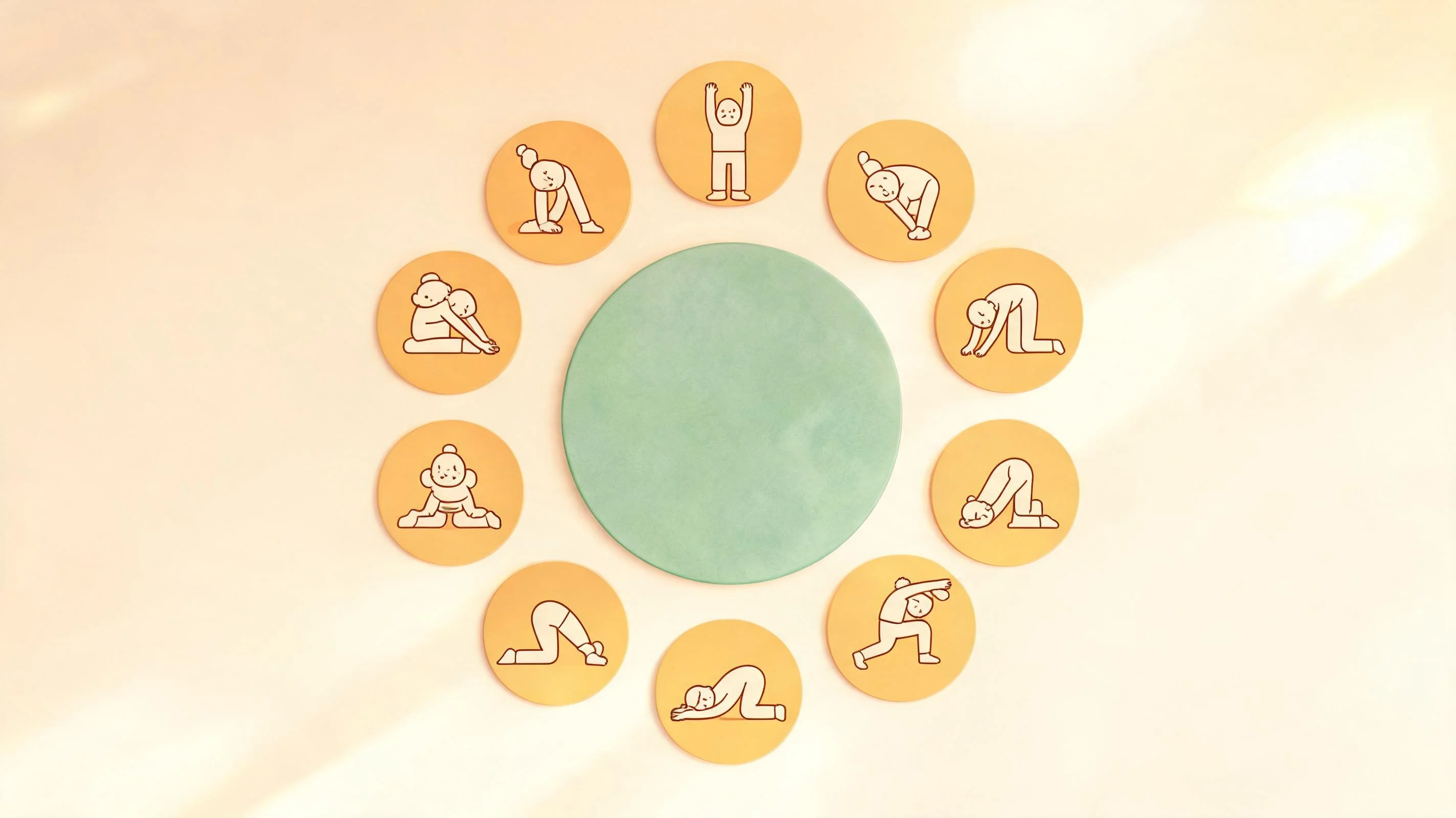
The ten stretches
Hold each for about 30 seconds per side where relevant, moving with slow breath. Total: about ten minutes.
- Neck rolls (30s) — drop chin to chest, roll ear toward shoulder each side. Tiny range, no forcing.
- Cat-cow (60s) — hands under shoulders, alternate arching and rounding at the pace of your breath.
- Child's pose (45s) — knees wide, arms forward, hips heavy toward heels.
- Downward dog (45s) — from all fours, lift hips high; bend knees generously, pedal the heels.
- Low lunge, each side (45s/side) — back knee down on the mat, chest tall; the hip flexor wakes up here.
- Standing forward fold (45s) — soft knees, let the head hang; sway gently side to side.
- Standing quad stretch, each side (30s/side) — heel to glute, knees together, hold something if needed.
- Seated spinal twist, each side (30s/side) — sit cross-legged, twist gently away from the lead shoulder.
- Butterfly fold (45s) — soles together, knees wide, hinge forward from hips with a long spine.
- Savasana or standing breath (60s) — lie flat or stand tall; five slow breaths, longer exhales.
That's the whole sequence. It loops neatly: end standing, ready to start the day.
Timing and breathing
Two rules make any stretch routine work:
- Exhale deeper than you inhale. The exhale is the release signal; muscles let go on the out-breath.
- Never bounce. Static holds of 20-40 seconds lengthen tissue safely; bouncing triggers protective contraction instead.
Physical therapists at Hinge Health emphasize exactly this for their morning-stretch protocols: slow entries, steady holds, easy exits.
Beginner mistakes to skip
- Chasing pain. Stretch sensation lives around mild tension; sharp pain is a stop sign, not progress.
- Skipping the warm-up moves. Cat-cow before deep folds — cold hamstrings complain loudly.
- Comparing day one to day thirty. Range changes weekly, not instantly.
- Practicing on hard floors barefoot-kneed. A dense mat isn't luxury here; kneecaps meet bone-level pressure without one.
If your floor is unforgiving, upgrade the surface once and the habit stops costing comfort — a roomy option like the GXMMAT Large Yoga Mat 6'x4' gives knees and wrists real padding, while shared households can split zones across a GXMMAT Large Yoga Mat 6'x8' so two people stretch without elbow collisions.
Bottom line
Ten familiar stretches, thirty seconds each, on a mat that's already waiting when you wake up. Breathe out into the tension, skip the pain-chasing, and let consistency do the compounding. In a few weeks the question won't be whether you have time — it'll be how the morning feels without it.