
Key Takeaways
- Check what the venue provides first — most retreat centers supply mats, blocks, straps and bolsters; bringing your own adds weight but guarantees hygiene and grip familiarity.
- Match your mat to the journey — a travel mat under 1.5 kg earns its space in carry-on; a full-size mat makes sense when you are driving or checking bags.
- Climate drives the packing list — tropical, temperate and mountain settings each demand different layers, sun protection and insect strategy.
- Send participants a packing list 4-6 weeks out — it answers questions before they arrive and reduces last-minute chaos.
- Build a venue equipment audit into your contract — confirm prop counts, condition, backup plan for outdoor sessions and who handles cleaning between uses.
The logistics mindset
A retreat is not a bigger class — it is a multi-day production where equipment, climate, travel and venue all interact. The International Yoga Conference frames it bluntly: planning a yoga retreat is a logistics problem dressed up as a spiritual one. Get the order right and the rest follows.
The equipment conversation is the piece most first-time hosts underestimate. You are not building a studio from scratch in your luggage — you are supplementing what the venue already has, accounting for the travel itself, and planning for conditions (heat, humidity, cold floors, outdoor wind) that your home studio never throws at you.
Step 1: Audit the venue before you pack
The single most useful thing you can do is read the venue's welcome materials and note exactly what they supply. Most retreat centers provide:
- Yoga mats (quantity and condition vary widely)
- Blocks, straps, bolsters, blankets
- Meditation cushions
- Towels and linens
- Meals and filtered water
What they do not always provide: yoga towels for hot sessions, personal bolster covers, resistance bands, portable speakers for outdoor practice, or backup mats in case of damage.
The venue audit checklist
Before signing the contract, ask:
- How many mats do you have, and what condition are they in?
- Are props shared across all groups or dedicated to our session?
- What happens if a mat tears mid-retreat — is there backup stock?
- Who cleans mats between sessions, and with what products?
- Is there a dedicated indoor practice space, and what is the weather contingency for outdoor sessions?
- Does the practice space have power outlets for speakers and lighting?
- What is the floor surface — hardwood, tile, grass, concrete?
RetreatVenues recommends a physical visit or live video walkthrough before signing — photographs mislead on outlet placement, floor quality and space dimensions.
Step 2: Choose your mat for the journey
The retreat mat decision is not about finding the best mat in the world — it is about finding the right mat for this specific trip.
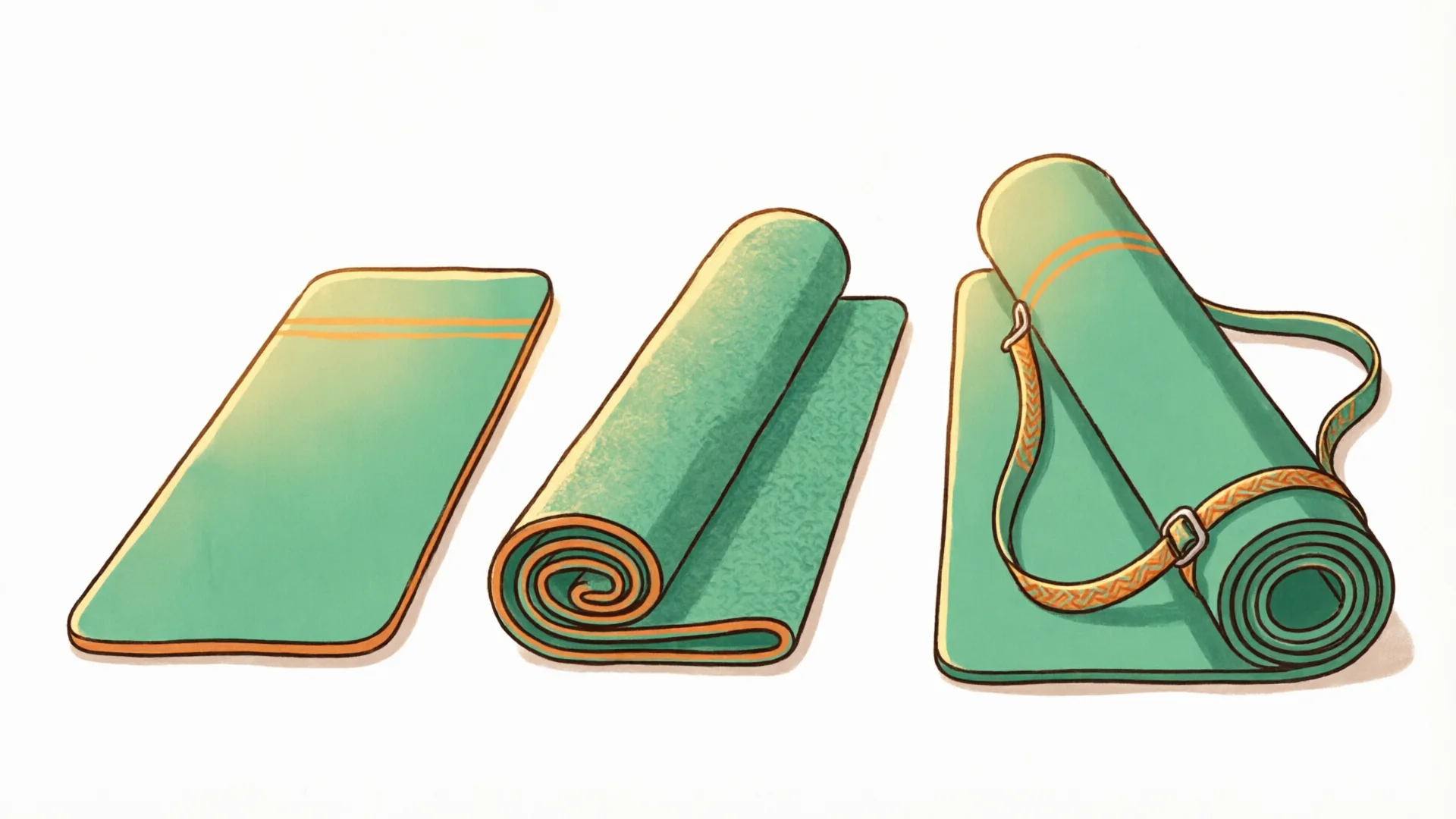
Travel mat (under 1.5 kg)
Best for: fly-carry-on retreats, tropical settings where floors are warm, multi-destination trips. Trade-offs: thinner (1.5-2mm), less cushioning, needs a clean surface underneath.
Foldable mat (slightly thicker)
Best for: longer retreats, teacher training courses, situations where you practice twice daily and need more joint protection. Still packable but heavier.
Full-size mat
Best for: driving distance, destination retreats where you check bags, teachers who supply mats for their group. Maximum grip and cushioning but maximum luggage weight.
Mat towel overlay
Best for: hygiene on shared venue mats, hot yoga sessions, anyone who wants grip without carrying a full mat. Lightweight, fast-drying, doubles as a regular towel.
Step 3: Pack by climate
Tropical and beach settings (Southeast Asia, Costa Rica, Mexico)
- 3-5 sets lightweight moisture-wicking activewear (avoid cotton — it stays damp)
- Swimsuit, sandals that handle wet paths
- Mineral sunscreen SPF 30+, natural insect repellent
- Lightweight rain jacket (rainy season can hit without warning)
- Yoga towel for every session — humidity turns any mat into a slip-and-slide within minutes
- Reusable water bottle with electrolytes
Temperate settings (European countryside, coastal Portugal, New Zealand)
- Morning and evening layers: light shawl for pranayama and savasana when body temperature drops
- Lightweight wind-resistant jacket even in summer
- Comfortable walking shoes for excursions
- 2-3 yoga sets if laundry is available at the venue
Mountain and cold-weather settings
- Thermal base layers, warm socks, heavier fleece or down layer for evenings
- Practice spaces may range from heated studios to open-air platforms — pack for the colder scenario
- Hot water bottle or warm wrap for evening restorative sessions
Step 4: The teacher's equipment kit
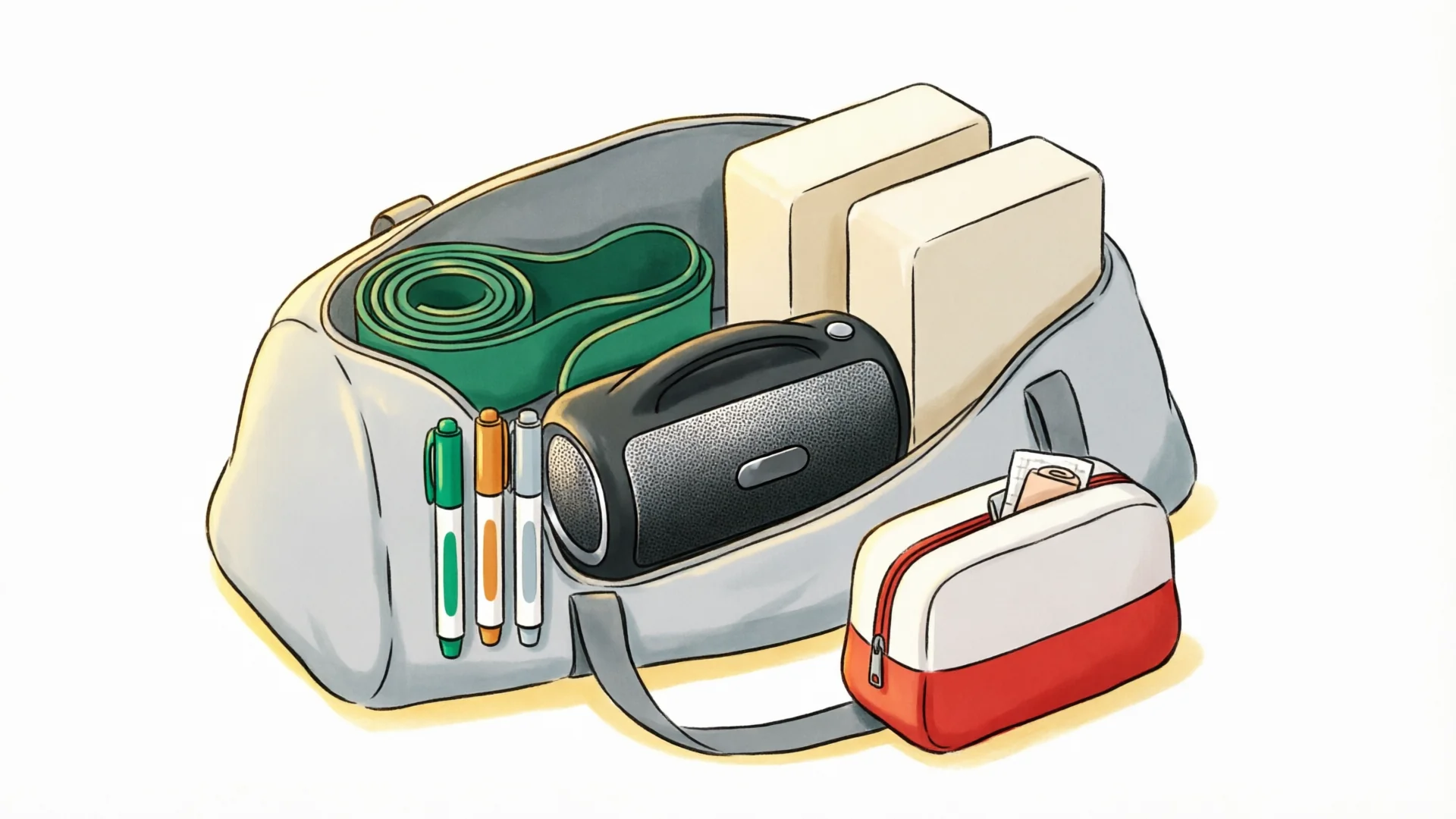
As an instructor, you carry a dual load: you guide the practice and you model preparedness. Beyond your personal mat, bring:
- A concise set of props you consistently use in class (your personal blocks, strap, small bolster)
- A compact whiteboard or dry-erase board for demonstrating sequences
- A pose deck for quick references during dynamic classes
- Your own speaker and playlist loaded offline (venues may not have compatible audio setups)
- Printed handouts or journals for the specific workshop topics
- A small first-aid kit: pain relievers, adhesive bandages, anti-inflammatory cream — intensive practice produces muscle soreness on days two and three

Step 5: Send participants a packing list
A clear packing list answers questions before they arrive and reduces the volume of individual messages. Structure it in three tiers:
Must bring
- Valid ID and travel documents
- Comfortable clothing and layers
- Personal medications and basic toiletries
- A journal and pen
Recommended
- Personal mat or mat towel (even if the venue provides mats)
- Yoga towel for hot sessions
- Sunscreen and insect repellent for outdoor practice
- Comfortable sandals and walking shoes
Leave at home
- Heavy jewelry or valuables
- Large makeup kits (retreats start early and end sweaty)
- More than two pairs of shoes
- Expectation of constant connectivity (many retreats limit screen time)
Send the list 4-6 weeks before departure, then reshare key items 1-2 weeks out. The packing list is also where you clarify what the venue provides — this prevents the "do I need to bring my own blocks?" messages.
The equipment factor at retreat scale
When you teach a regular class, one good mat is enough. At retreat scale — multiple sessions per day, shared equipment, outdoor conditions, travel wear — the consistency of your mat surfaces matters more. A retreat where students grip confidently through day three is fundamentally different from one where half the group is adjusting to unfamiliar, worn-out venue mats.
For teachers who run retreats regularly, investing in a portable set of reliable mats for your group eliminates the variable entirely. Something like the GXMMAT Travel Yoga Mat Pick — designed for portability without sacrificing the grip surface students need — means your retreat participants practice on consistent equipment regardless of what the venue provides.
Bottom line
Retreat logistics succeed when you treat equipment as a system, not an afterthought. Audit the venue before you commit, match your mat to the journey and climate, send participants a clear packing list early, and build your teacher kit around portability and reliability. The spiritual transformation happens on the mat — but only if the mat is actually ready for the conditions you are bringing it into.